
Introduction
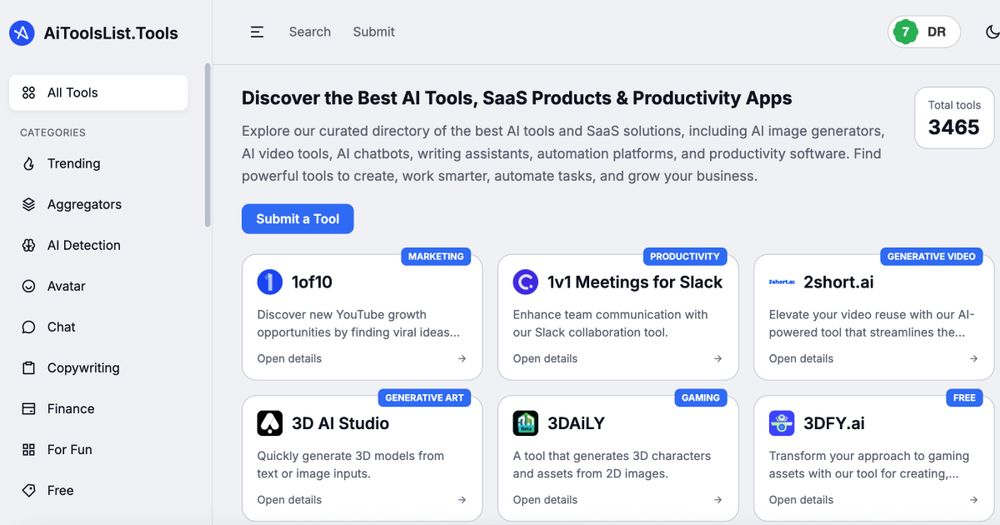
AiToolsList.Tools is a curated online directory that catalogs AI tools, SaaS products, and productivity applications. The platform serves as a discovery hub for professionals and businesses seeking software solutions across categories including image generation, video editing, chatbots, writing assistants, automation platforms, and workflow optimization tools.
Unlike algorithmic aggregators that scrape and list every available tool, AiToolsList.Tools positions itself as a curated resource, suggesting human review or editorial oversight in its selection process. The directory targets creators, developers, marketers, and business operators who need to navigate the rapidly expanding landscape of AI-powered software without evaluating dozens of similar options individually.
The platform operates on a submission model where tool creators can suggest their products for inclusion, and maintains an active feedback mechanism for reporting outdated information or broken links.
Key Features
Curated Directory Structure AiToolsList.Tools organizes its catalog into distinct categories including AI Detection, Generative Art, Generative Code, Generative Video, Image Improvement, Image Scanning, Motion Capture, Productivity, and Prompt Guides. This taxonomy helps users browse purposefully rather than scrolling through undifferentiated listings.
Multi-Modal Discovery The directory covers tools spanning multiple use cases: AI image generators for visual content creation, video tools for editing and repurposing, chatbots for communication automation, writing assistants for content production, and platforms for business workflow optimization.
Submission System Tool creators and users can submit new AI tools or SaaS products for directory inclusion. This crowdsourced approach expands coverage while the curation process maintains quality standards.
Search Functionality A search interface allows users to find specific tools by name, category, or functionality rather than browsing through category pages exclusively.
Listing Update Mechanism The platform accepts requests for edits to existing listings, including corrections to descriptions, feature updates, logo replacements, and URL changes. This keeps directory information current as tools evolve.
Broken Link Reporting Users can report broken external links or missing assets, helping maintain directory accuracy and user experience.
Use Cases
Tool Discovery for Creators Content creators seeking AI image generators, video editing tools, or motion capture software can browse category-specific listings to compare options and find tools suited to their creative workflows.
Developer Resource Finding Developers looking for generative code tools, LLM integration platforms, or UI component generators can identify relevant solutions without extensive independent research.
Business Process Optimization Organizations seeking automation platforms, productivity software, or AI-powered business tools can evaluate curated options across categories relevant to their operational needs.
Marketing Technology Stack Building Marketing professionals can discover writing assistants, SEO tools, social media automation platforms, and campaign optimization software through targeted category browsing.
Research and Evaluation Teams evaluating multiple tools for specific use cases can use the directory as a starting point for creating shortlists, then conduct deeper evaluation of promising options.
Partnership and Collaboration Discovery The directory serves as a venue for tool creators to identify potential integration partners, complementary products, or sponsorship opportunities within the AI ecosystem.
Pricing
AiToolsList.Tools operates as a free resource for users browsing the directory. There is no charge for:
- Searching the directory
- Browsing tool listings
- Accessing category pages
- Viewing tool descriptions and features
For tool creators, the submission process appears to be free as well, though specific details about featured listings, sponsored placements, or premium directory positions are not disclosed in available materials.
The platform may generate revenue through partnerships, sponsorships, or affiliate relationships with listed tools, though this is not explicitly confirmed in source content.
User Experience and Support
Directory Navigation The site structure emphasizes category-based discovery alongside search functionality. Users can drill down from broad categories (AI image generators) to specific tool listings with descriptions and external links.
Submission Process Tool creators can submit products through a structured process, likely including form-based applications with details about the tool's functionality, target users, and unique value propositions.
Feedback Channels The platform provides multiple contact pathways:
- General inquiries via email
- Listing update requests
- Broken link reports
- Partnership discussions
- Site structure feedback
Response Expectations The site acknowledges email review timelines and requests specific information (tool name, page URL, requested updates) to expedite listing correction processing.
Content Maintenance By encouraging user reports of outdated information and broken links, the directory employs distributed quality control to maintain accuracy as the AI tool landscape evolves rapidly.
Technical Details
Platform Integrations Referenced The directory catalogs tools with integrations across popular platforms including:
- Slack (collaboration and communication tools)
- WordPress (content management and hosting solutions)
Tool Categories Covered
- AI Detection: Tools for identifying AI-generated content
- Generative Art: Image and visual content generation
- Generative Code: AI-powered coding assistants and code generators
- Generative Video: Video creation, editing, and repurposing tools
- Image Improvement: Enhancement and optimization utilities
- Image Scanning: OCR and visual analysis tools
- Motion Capture: Animation and movement tracking software
- Productivity: Workflow and task management applications
- Prompt Guides: Resources for optimizing AI interactions
Listing Information Each tool listing typically includes:
- Tool name and brief description
- Primary functionality and use cases
- Category classification
- External link to tool website
- Logo or visual identifier
Pros and Cons
Pros
- Curated approach potentially filters low-quality or spam tools
- Category taxonomy enables purposeful browsing by use case
- Submission system allows new tools to gain visibility
- Update mechanism helps maintain accuracy as tools evolve
- Free access for users researching tools
- Multi-category coverage spans the full AI tool ecosystem
- Broken link reporting engages community in quality maintenance
- Partnership inquiries suggest openness to ecosystem collaboration
Cons
- Curation standards not explicitly defined-unclear what criteria tools must meet
- No user reviews or ratings visible to gauge tool quality beyond description
- Limited depth in tool listings-descriptions may be marketing copy rather than evaluation
- No comparison functionality to evaluate similar tools side-by-side
- Monetization model not transparent-unclear if listings are paid placements
- No verification badges or trust indicators for vetted tools
- Submission and update request processing times not specified
- Directory size and coverage unclear from available information
FAQ
What types of tools are included in AiToolsList.Tools? The directory catalogs AI tools, SaaS products, and productivity applications across categories including image generators, video editors, chatbots, writing assistants, automation platforms, code generators, motion capture software, and business workflow tools. Coverage spans creative, technical, and operational use cases.
How are tools selected for inclusion in the directory? Tools appear to be submitted by creators or users, then curated for inclusion. The exact review criteria and editorial standards are not publicly detailed, though the platform describes itself as "curated," suggesting some quality control beyond open listing.
Can I submit my AI tool to the directory? Yes. Tool creators can submit new AI tools or SaaS products through the submission system. The process likely involves providing tool descriptions, categorization, screenshots or logos, and external website links for review.
How do I request updates to an existing listing? Contact the platform via email with the tool name, relevant page URL, requested changes, and any supporting details or documentation. Including specific information helps process corrections faster.
Is AiToolsList.Tools free to use? Yes. Browsing the directory, searching for tools, and accessing listings is free for users. Tool submissions also appear to be free, though premium placement or featured listings may involve fees not disclosed in available materials.
What should I do if I find a broken link or outdated information? Report broken external links, missing logos, or outdated product information via email. Include the tool name, page URL, and details about what needs correction to help the team process your request quickly.
Does AiToolsList.Tools review or endorse the tools listed? The platform describes itself as a curated directory but does not appear to provide formal reviews, ratings, or endorsements. Listings likely represent tool-provided descriptions rather than independent evaluation. Users should conduct their own due diligence before adopting tools.
How can I partner with AiToolsList.Tools? The platform accepts inquiries about partnerships, collaborations, and sponsorship opportunities. Contact via email to discuss potential arrangements for featured placement, content collaboration, or ecosystem integration.
Are there filters for finding tools by integration or platform? While category browsing is available, specific filtering by integration (e.g., "Slack integrations only") or platform compatibility is not clearly documented in available materials. Users may need to browse categories or use search functionality.
How current is the directory information? The platform actively solicits updates and broken link reports to maintain accuracy. However, the AI tool landscape evolves rapidly, and some listings may become outdated between review cycles. Users should verify current features and pricing directly with tool providers.
Conclusion
AiToolsList.Tools occupies a familiar position in the software ecosystem: the curated directory attempting to bring order to a fragmented and rapidly expanding market. For users overwhelmed by the sheer volume of AI tools launching daily, a filtered discovery resource offers genuine value-provided the curation maintains sufficient quality standards.
The platform's category structure demonstrates thoughtful organization, grouping tools by function rather than forcing users to parse undifferentiated lists. The submission and update mechanisms suggest operational maturity, acknowledging that directories require active maintenance to remain useful as tools evolve or disappear.
However, the lack of transparent curation criteria, user reviews, or independent evaluation raises reasonable questions about listing quality. Without knowing whether inclusion requires meeting specific standards or merely submitting an application, users cannot fully trust the directory as a quality filter. The apparent absence of monetization disclosure also leaves open whether listings are editorially selected or commercially purchased.
For tool creators, AiToolsList.Tools offers visibility in a crowded marketplace at what appears to be low or no cost. The partnership inquiry pathway suggests opportunities for deeper collaboration beyond basic listings.
The platform's ultimate value depends on execution: how consistently curation maintains quality, how quickly updates process, and whether the directory grows comprehensive enough to reduce the need for additional research. As a starting point for tool discovery, it appears functional. As a definitive resource for AI tool selection, it likely requires supplementation with user reviews, independent testing, and direct tool evaluation.
Users should approach AiToolsList.Tools as one input among many in their tool selection process-useful for surfacing options, but not sufficient for final decisions without further investigation.