
Introduction
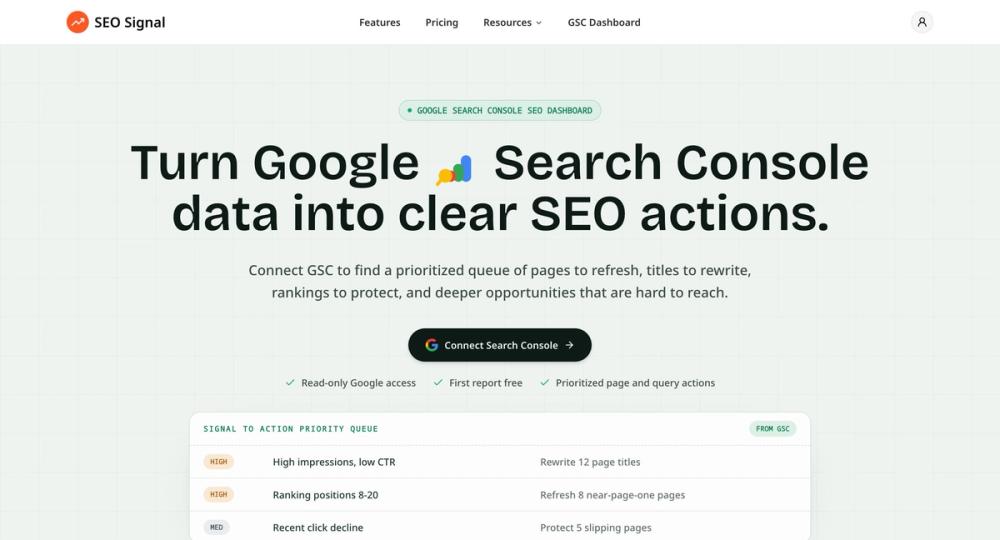
SEO Signal is a Google Search Console analytics dashboard that turns raw search performance data into a prioritized action queue. Rather than relying on abstract audit scores or third-party estimates, the tool works directly with real GSC metrics - clicks, impressions, CTR, and average position - to surface pages that deserve attention first. For website operators, content creators, and small teams who already use Google Search Console but struggle to translate its data into concrete next steps, the tool appears designed to bridge that gap with a focused, action-oriented interface.
Key Features
- Opportunity Queue - Builds a prioritized SEO action list from recent page and query performance. Rather than dumping every flagged issue into a flat list, the queue ranks tasks by likely impact, helping users decide whether to rewrite a title, expand a thin page, or investigate a ranking decline.
- CTR Diagnosis - Compares impression volume against click-through rate and ranking position to identify pages that appear frequently in search results but get skipped. The tool then suggests title or snippet rewrites as specific, actionable tasks.
- Content Groups - Organizes pages by content type or topic, enabling users to evaluate entire site sections rather than single URLs. This view appears particularly useful for tracking performance across blog categories, product pages, or localized subfolders.
- Rank Tracking - Monitors selected search queries and page positions over time, providing a focused view of keyword movement without requiring manual GSC exports and spreadsheet filtering.
- Lost and New Detection - Surfaces URLs and queries that gained or disappeared between two time windows, helping users catch emerging opportunities or traffic declines before they compound into larger problems.
Use Cases
For solo website operators running a blog or niche project, SEO Signal offers a structured way to turn GSC data into a content calendar. The dashboard surfaces which posts need updates, which titles are underperforming relative to their impression count, and where quick wins sit within a few ranking positions of page one - all without manual CSV exports.
For small teams or agencies managing multiple client websites, the content-group and rank-tracking features make it easier to report on entire site sections rather than cherry-picking individual pages. The Growth and Scale plans support three and ten websites respectively, which suggests the tool is built to handle multi-property workflows without requiring separate subscriptions for each client.
For anyone focused on CTR recovery, the CTR Diagnosis view is the core draw. By cross-referencing impression data with click-through rates and query intent, the tool identifies pages where a stronger title or meta description could recover meaningful organic traffic - and presents these as concrete rewrite tasks rather than generic audit warnings.
Pricing
SEO Signal offers a free first report with read-only Google Search Console access and no credit card required. Paid plans start at $29 per month for the Solo tier, which covers one website, 50 content groups, 50 tracked rankings, 30-day GSC history, and up to 5,000 GSC rows per site with daily reports. The Growth plan at $49 per month expands to three websites, 150 content groups, 90-day GSC history, up to 10,000 GSC rows per site, and 24/7 support. The Scale plan at $99 per month covers ten websites with unlimited content groups, unlimited ranking tracking, unlimited GSC history, and daily data updates. All paid tiers include a 14-day free trial and accept monthly or annual billing - annual plans save two months. Full plan details are available on the pricing page.
User Experience and Support
The onboarding flow connects to Google Search Console via a one-click read-only access request, then immediately generates a first report with prioritized actions. This low-friction entry point is useful for evaluators who want to see real data before committing to a subscription. The dashboard organizes its information into six views - covering lost pages, lost queries, page movement, page indexing, opportunity lists, and CTR analysis - which keeps the interface focused without overwhelming new users.
Support is handled through a contact form, with response times varying by plan tier. Solo plan users can expect business-day responses, while Growth and Scale subscribers receive 24/7 support handling. The site also maintains a blog and resource section with guides on topics like content decay, CTR recovery, client communication, and reporting workflows, which can help users extract more value from the dashboard after initial setup.
Technical Details
SEO Signal integrates directly with Google Search Console through read-only API access, meaning the tool cannot modify GSC data or make changes to a site's search presence. Data updates happen automatically - every three days on the Solo plan and daily on Growth and Scale tiers. The platform also offers a Chrome Extension alongside the web dashboard for browser-based access. Payments and subscriptions are managed through Stripe, and the product is currently in Public Beta, which the site frames as an invitation for users to shape the tool's development in exchange for full feature access.
Pros and Cons
Pros
- Free first report with real GSC data allows hands-on evaluation before any payment commitment
- Prioritized action queue translates raw metrics into specific content tasks rather than abstract warnings
- CTR Diagnosis view targets a concrete, recoverable traffic opportunity that many SEO tools overlook
- Multi-site support on Growth and Scale plans suits agencies or operators managing several properties
- Read-only GSC connection means zero risk of accidentally modifying search data
Cons
- The Solo plan's three-day data update cycle may feel slow for time-sensitive content recovery work
- Support response times on the Solo tier are limited to business days, which could delay assistance during urgent ranking drops
- Full feature access is tied to the Public Beta status, which means pricing and plan limits could shift as the product matures
- Rank tracking and content group limits on lower tiers may constrain teams working with large, heavily segmented sites
FAQ
What is SEO Signal and what problem does it solve?
SEO Signal is a Google Search Console analytics dashboard that organizes raw GSC data into a prioritized list of SEO actions. The tool aims to reduce the friction of manually exporting and analyzing search performance by surfacing pages worth updating, titles to rewrite, and queries to monitor - all grounded in real impression and click metrics rather than estimated audit scores.
Who is SEO Signal best suited for?
The public site positions the tool for individual website operators, content creators, and small teams or agencies managing multiple properties. If you already rely on Google Search Console and want a more structured view of what to work on next, SEO Signal appears most relevant. Teams that need deep keyword research or competitive analysis beyond GSC data may find the scope limited compared to broader SEO platforms.
How does the CTR Diagnosis feature help with content refresh decisions?
The CTR Diagnosis view compares impression volume, click-through rate, and ranking position to find pages where Google already displays the result but searchers are not clicking. The tool then suggests title or snippet rewrites as specific tasks, making it a practical starting point for teams focused on recovering traffic from pages that are close to performing well.
What can users verify from the public site before signing up?
Users can verify the plan tiers and their specific limits, the one-click read-only GSC connection process, the six dashboard views available, content group and ranking tracking capabilities, and the CTR Diagnosis feature. The pricing page also lists GSC row limits, data update frequencies, and support response windows for each tier.
Does SEO Signal show pricing and support details publicly?
Yes. The pricing page lists three paid tiers with specific limits, a free first report, and a 14-day trial. Support is available through a contact form with response times that vary by plan tier. The site confirms read-only Google Search Console integration and mentions a Chrome Extension, though deeper API or export capabilities are not detailed on the public pages.
What should users confirm before committing to a paid plan?
A careful reader should verify whether the GSC data refresh frequency on the Solo plan (every three days) meets their reporting cadence, confirm that the GSC row limits on their chosen tier handle their site's query volume, and check whether the Public Beta status affects any guarantees around data retention, plan pricing stability, or uptime commitments.
Conclusion
SEO Signal takes a practical approach to GSC analytics by turning raw search data into a prioritized content action queue. For website operators and small teams who want to work from real performance signals rather than abstract audit scores, the free first report offers a low-risk way to evaluate whether the dashboard's framing fits their workflow. As the product remains in Public Beta, the current pricing and full-access model may shift over time, so trying the free tier and confirming plan details before a paid commitment is a reasonable approach.