
Introduction
Commune is a community platform built specifically for founders, makers, and builders who want a structured space to share progress, find collaborators, and grow alongside peers. If you have ever tried to stay connected with fellow indie hackers through sprawling social feeds or loose group chats, you know how quickly useful updates get buried under noise. Commune positions itself as a middle ground: more organized than Twitter threads, more focused than Discord servers, and designed around the working habits of people who are actively building products.
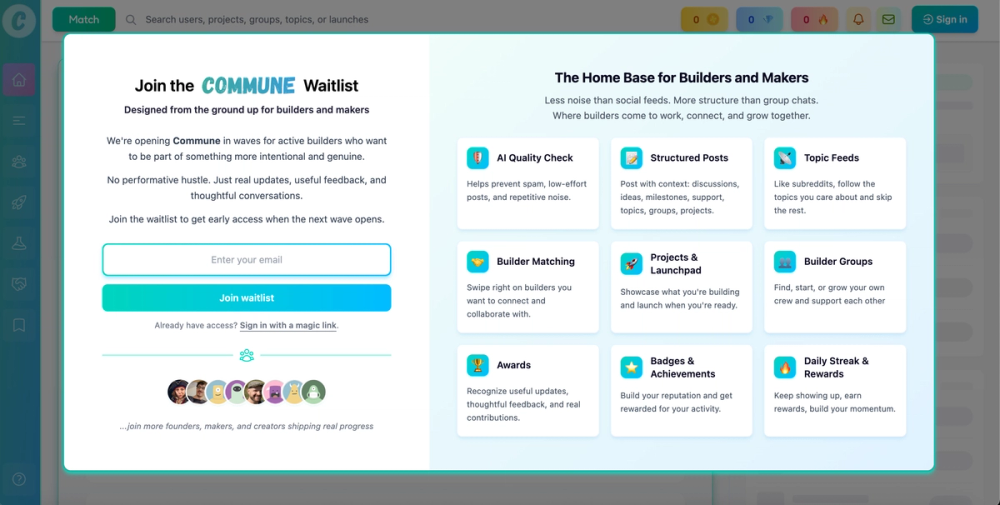
The public site presents Commune as "the home base for founders, makers, and builders," and the feature set backs that up. Rather than chasing viral content or follower counts, the platform emphasizes contextual posting, topical organization, and peer matching. For someone shipping a side project or running an early-stage startup, that framing matters. You are not performing for an audience; you are showing up in a space where everyone else is also building something.
Key Features
The platform's navigation reveals a clear feature structure that separates different types of activity:
- Topics work like subreddit-style channels, letting you follow discussions organized by subject matter. You can pick the areas most relevant to your work and filter out everything else.
- Groups provide smaller, more focused spaces where builders can find or form crews around shared interests. The site describes this as a way to "find, start, or grow your own crew and support each other."
- Launchpad appears to be the space for showcasing what you are building and coordinating launches. The site highlights this as the place to "showcase what you're building and launch when you're ready."
- Projects lets members maintain project profiles within the community, keeping your work visible to others who might want to follow along or collaborate.
- Match uses a swipe-based interface to connect you with builders who share your interests. The site describes this as "swipe right on builders you want to connect and collaborate with."
- Bookmarks provides a personal save system for content you want to revisit.
- Guide offers documentation or onboarding resources to help new members get oriented.
The platform also includes a reputation and rewards system. Members can "build your reputation and get rewarded for your activity" and "keep showing up, earn rewards, build your momentum." This suggests a gamification layer designed to encourage consistent participation without relying on follower metrics.
Commune supports sign-up through Google and X (formerly Twitter), as well as magic link authentication, lowering the barrier to getting started.
Use Cases
Solo founders looking for peer accountability. If you are building alone and need a circle of people who understand the startup grind, Commune's community structure gives you a place to post milestones, ask questions, and stay visible without navigating a noisy social feed.
Small teams seeking early feedback. The Launchpad and Projects features appear well-suited for sharing early versions of a product and collecting reactions from other builders. This is the kind of lightweight feedback loop that can matter before a public launch.
Makers who want structured networking. The Match feature and topic-based organization suggest that Commune is designed for intentional connection rather than random social browsing. If you want to find collaborators or mentors in a specific domain, the platform's structure supports that.
Community builders testing a new audience. If you are exploring whether a product idea has traction among indie hackers and builders, posting in relevant topics and groups could help you gauge interest before investing in a full marketing push.
It is worth noting that evidence for specific use cases is limited to what the homepage communicates. The depth of each feature area may differ from what the landing page suggests, so evaluating the actual experience after signing up would be a reasonable next step.
Pricing
The fetched homepage does not display explicit pricing information. The platform advertises a free account signup, and the references to "resources," "diamonds," and "daily streak" rewards suggest there may be a freemium model, but the specifics of any paid tiers or limits are not visible on the public page. You would need to create an account or look for a pricing page to understand the full cost structure.
User Experience and Support
Commune's homepage emphasizes simplicity and reduced noise as core design principles. The tagline "less noise than social feeds, more structure than group chats" suggests the interface is intentionally scoped to keep conversations productive. The navigation sidebar includes Home, Topics, Groups, Launchpad, Explore, Match, Bookmarks, and Guide, which points to a fairly organized information architecture.
The platform appears to include a built-in search feature with navigation-scoped results, based on the search functionality visible on the page. Sign-up supports Google, X, and magic link authentication, which reduces friction for new users.
A Guide section is accessible from the main navigation, suggesting some level of onboarding documentation exists. Beyond that, details about live support, help centers, or community forums for platform issues are not visible on the homepage. Prospective users may want to check whether in-app help or responsive support channels exist before committing to the platform as their primary community space.
Technical Details
Based on the homepage evidence, Commune appears to be a web-based application. The navigation and UI elements suggest it is built with a modern frontend framework using component-based architecture (the source contains Alpine.js directives and reactive UI patterns). Sign-up supports Google and X OAuth, as well as magic link email authentication.
No information about API availability, mobile apps, third-party integrations, or deployment infrastructure is visible on the public page. If you need integrations with tools like Slack, Notion, or GitHub, or if mobile access is important to your workflow, those details would need to be verified directly on the platform.
Pros and Cons
Pros:
- Purpose-built for the builder and maker community, so the audience is naturally aligned
- Topic-based organization reduces noise and keeps discussions relevant
- Match feature provides a structured way to find collaborators beyond random networking
- Reputation and rewards system encourages consistent, meaningful participation
- Multiple authentication options including Google, X, and magic links lower signup friction
- The platform appears lightweight and focused rather than trying to be everything at once
Cons:
- Pricing details are not visible on the homepage, making it hard to evaluate the full cost before signing up
- Only the homepage was available for review, so the depth of features like Groups, Launchpad, and Match cannot be fully assessed from the outside
- No visible information about mobile apps, API access, or third-party integrations
- The community's size and activity level are unclear from the public page alone
- The reputation and rewards system may feel unnecessary for users who prefer a straightforward discussion space
- Limited publicly available documentation beyond the Guide section
FAQ
What kind of people use Commune?
The platform is designed for founders, makers, and builders. Based on the homepage, the community skews toward indie hackers, early-stage startup founders, and people working on side projects who want a structured space to share updates and connect with peers. It does not appear to target enterprise teams or non-technical audiences.
How does the Match feature work?
Match uses a swipe-based interface where you can indicate interest in connecting with other builders. The site describes it as a way to "swipe right on builders you want to connect and collaborate with." Beyond the basic mechanic, details about matching algorithms, conversation features, or connection limits are not visible on the public page, so trying it firsthand is the best way to evaluate it.
Is Commune free to use?
The homepage advertises a free account signup and references to in-platform rewards like "diamonds" and "daily streaks" suggest a freemium structure. However, no explicit pricing tiers or paid plan details are visible on the public page. You would need to create an account or look for additional pricing information to understand what is included at each level.
Can I use Commune on my phone?
No information about mobile apps or mobile-optimized access is visible on the homepage. The platform is web-based and accessible through a browser, but whether there is a dedicated mobile app or responsive design optimized for phone use is not clear from the public evidence. This is worth checking before relying on it for on-the-go updates.
How is Commune different from a Discord server or Slack community?
The public page positions Commune as having "less noise than social feeds" and "more structure than group chats." The key differences visible from the evidence include topic-based organization (rather than channel sprawl), a built-in Match feature for intentional networking, a Launchpad for showcasing projects, and a reputation system tied to participation quality. Whether those differences matter to you depends on how much structure your current community setup is missing.
Does Commune support integrations with other tools?
No integration information is visible on the homepage. There is no mention of connections to GitHub, Slack, Notion, or other tools that builders commonly use. If integration with your existing workflow is important, this would be something to verify after creating an account or reaching out to the platform directly.
What does the reputation and rewards system actually do?
The site mentions that you can "build your reputation and get rewarded for your activity" and references "diamonds" and "daily streaks." The exact mechanics of how reputation is calculated, what rewards are available, and whether reputation affects visibility or access within the community are not detailed on the public page. This is another area where hands-on experience would provide clearer answers.
Conclusion
Commune fills a specific niche: a community platform designed around the working patterns of builders and makers, with features that encourage structured sharing, intentional networking, and consistent engagement. The topic-based organization, Match feature, and Launchpad suggest a product shaped by the real needs of indie hackers and early-stage founders, rather than a generic social network with a developer label bolted on.
If you are building something and want a community space that is more focused than social media but more structured than a group chat, Commune is worth exploring. The free signup makes it low-risk to evaluate, though you should verify details about pricing tiers, mobile access, and integrations that are not visible on the public homepage. Visit Commune to see whether the platform fits the way you work.