
Introduction
Supadrop is a static site hosting service that turns file uploads into live URLs in roughly 30 seconds. Drop a ZIP, HTML, or PDF file and the platform assigns a subdomain, generates an SSL certificate, and hands back a shareable link with an optional QR code. Built for non-technical users - restaurant owners posting menus, freelancers sharing resumes, creators deploying vibe-coded apps - Supadrop strips away servers, configuration files, and command-line tools in favor of a drag-and-drop workflow.
Key Features
- Instant Deployment - Upload a ZIP containing HTML, CSS, and JS files (or a single HTML/PDF) and the site goes live in under 30 seconds. No build step, no CLI, no config files. The demo video on the homepage shows a restaurant menu PDF becoming a public URL in real time.
- QR Code Generation - Every deployed site gets a one-click QR code, which the site highlights for restaurant tables, event posters, resume handouts, and anywhere print meets digital.
- Automatic SSL and Subdomain - Each deployment receives an HTTPS certificate and a
.supadrop.sitesubdomain out of the box. The free tier includes this with no extra configuration. - Update Anytime - Drop new files or edit directly in the dashboard to push changes. The site frames this as useful for menu updates, typo fixes, or refreshed pricing without redeploying from scratch.
- API and Workflow Automation - A REST API lets external tools like n8n, Hermes, or OpenClaw publish and update sites programmatically. A promotional code (SUPAPI) offers 50% off Pro and Large plans for API users.
Use Cases
For restaurant and cafe owners who need a digital menu accessible via QR code, Supadrop's workflow is direct: upload a PDF or HTML menu, print the generated QR code, and place it on tables. Updating the menu later means dropping new files without touching DNS or hosting settings.
For freelancers and job seekers who want a quick online presence - a portfolio page, a project showcase, or a clickable resume - the drag-and-drop approach removes the need for GitHub Pages, Netlify, or any developer-oriented hosting. The site suggests this is explicitly built for people, not developers.
For creators using AI-assisted code generators like Lovable, Bolt, or Cursor, Supadrop positions itself as a deployment target. The "vibe coded app" framing on the homepage speaks to users who build small sites with AI tools but need a simple place to host the output.
Pricing
Supadrop offers a 15-day free trial with no credit card required: 1 site, 50 MB storage, SSL certificate, unlimited traffic, and a subdomain. Paid plans are available monthly or yearly (up to 29% savings on annual). The site also offers a promotional code SUPAPI for 50% off Pro and Large plans when using the API. Exact paid-tier pricing beyond the free trial is not detailed on the fetched homepage - the pricing section is referenced but the specific dollar amounts for Pro and Large plans are cut off in the evidence.
User Experience and Support
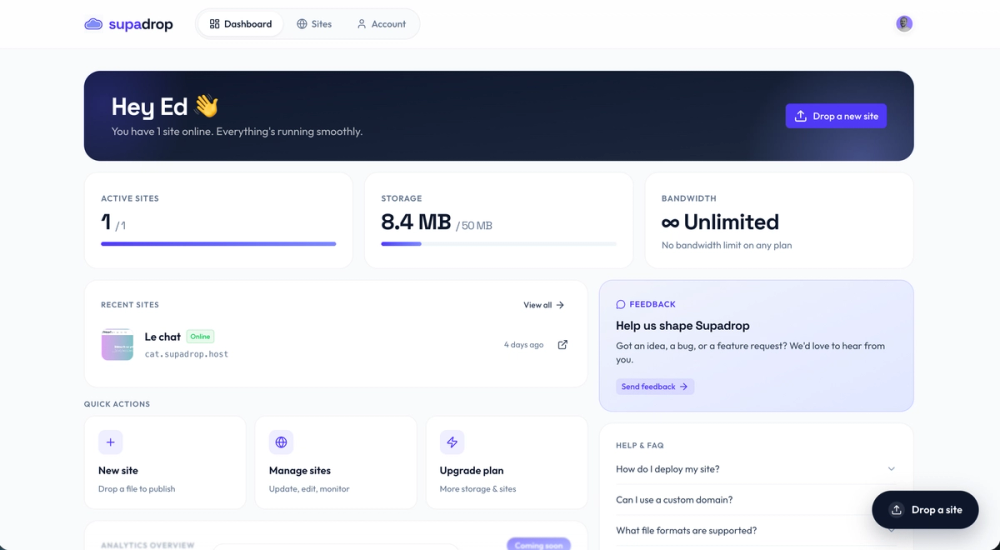
The interface is minimal: drag a file onto the upload area, wait for the deployment, and copy the generated link. The homepage includes a 28-second demo video showing the end-to-end flow. A blog, FAQ, and API documentation page are linked in the navigation. Support channels beyond the FAQ are not prominently visible on the fetched pages.
Technical Details
Supadrop deploys static sites - HTML, CSS, JS, and assets - to its infrastructure. The REST API supports file uploads and deployment management, suggesting a standard static hosting backend. SSL certificates are provisioned automatically. The platform assigns .supadrop.site subdomains. Bandwidth is described as unlimited on the free tier. The site does not detail edge locations, CDN infrastructure, or server locations on the public pages.
Pros and Cons
Pros
- Truly instant deployment - file upload to live URL in under 30 seconds with no configuration
- Free 15-day trial with no credit card, SSL, unlimited traffic, and a subdomain included
- QR code generation built in, which is genuinely useful for physical-world use cases
- REST API enables automation and integration with AI code generators and workflow tools
- Update-in-place without redeploying from scratch
Cons
- Free trial limited to 1 site and 50 MB storage, which constrains evaluation for larger projects
- Paid-tier pricing details are not fully visible on the fetched homepage
- Static-only hosting - no server-side rendering, databases, or backend functionality
.supadrop.sitesubdomain on the free tier may not suit professional branding needs- Support channels beyond the FAQ are not prominently documented
FAQ
What is Supadrop and who is it for?
Supadrop is a static site hosting service that lets you upload HTML, CSS, JS, or PDF files and get a live URL in under 30 seconds. It's built for non-technical users - restaurant owners, freelancers, creators, and anyone who needs a quick web presence without server configuration.
Do I need to know how to code?
No. Supadrop is designed for people, not developers. Drag a file onto the upload area, and the platform handles hosting, SSL, and subdomain assignment. The site explicitly states no coding, no config, and no setup required.
What file types are supported?
The platform accepts ZIP files containing HTML, CSS, and JS, as well as individual HTML and PDF files. The homepage demonstrates deployment of both a website ZIP and a restaurant menu PDF.
Is there a free plan?
Yes. The 15-day free trial includes 1 site, 50 MB storage, an SSL certificate, unlimited traffic, and a .supadrop.site subdomain - all with no credit card required.
Can I use my own domain?
The fetched homepage evidence does not detail custom domain support. The free tier assigns a .supadrop.site subdomain, and custom domain options may exist on paid plans, but this should be verified on the pricing page.
Does Supadrop offer an API?
Yes. The REST API supports file uploads and deployment management, enabling automation with tools like n8n, Hermes, or OpenClaw. A promotional code (SUPAPI) offers 50% off Pro and Large plans for API users.
Conclusion
Supadrop delivers on its core promise: file-to-URL deployment in under 30 seconds with no technical friction. The QR code generation and API automation are practical additions that differentiate it from generic static hosts. For non-technical users who need a quick web presence - whether for a restaurant menu, a freelance portfolio, or a vibe-coded prototype - the workflow is genuinely simple. The main limitation is the static-only scope and the need to verify paid-tier pricing and custom domain support before committing beyond the free trial.