
Introduction
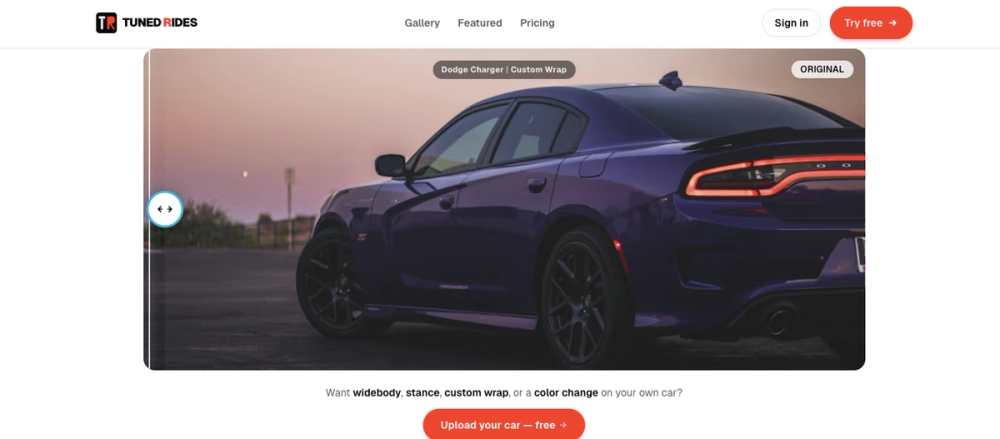
If you have ever spent hours scrolling through aftermarket catalogs wondering whether a widebody kit will suit your specific car, you already understand the core problem that TunedRides tries to solve. The platform lets you upload a photo of any vehicle and receive a photoreal AI render of that car in a chosen modification style within roughly 30 seconds, without creating an account. It is aimed at car owners planning a build, wrap shops previewing jobs for clients, and enthusiasts who want to see the visual impact of a modification before committing real money.
What makes the tool notable in a crowded field of automotive visualization options is its photo-first approach. Rather than placing a generic 3D model into a scene, TunedRides applies the modification directly to your car's existing body lines, color, and surrounding environment. The public page presents this as a quick, free starting point for build planning, with paid tiers available for higher-quality downloads.
Key Features
The site highlights eight modification categories that cover the most common aftermarket directions in car culture:
- Widebody Kit - Liberty Walk, Rocket Bunny, Pandem, and RWB-style fender extensions and full-body transformations.
- Stance - Air-ride and fitment-focused renders emphasizing camber, ride height, and wheels-to-fender alignment.
- Slammed - Bagged and hardparked styles that push the car as low as possible.
- JDM Style - Liberty Walk, RWB, Veilside, and Origin Lab-inspired Japanese tuner builds.
- Drift Build - Formula D and grassroots-inspired missile car to competition-spec configurations.
- Custom Wrap - Color shift, chrome, full livery, and matte wrap designs applied before a real install.
- Color Change - Candy, paint, matte, metallic, and factory respray renders.
Beyond the styles themselves, the platform works on any car make and year. You can upload your own photo or choose from over 200 stock models in the library. The workflow is three steps: upload, pick a style, download. Free renders include a watermark; the Pro tier removes it and adds HD upscaling.
The site also maintains a content library of car modification guides covering topics such as color PPF versus vinyl wrap, chrome delete costs, and leased car wrapping, which suggests an ongoing editorial effort rather than a purely tool-focused product.
Use Cases
Car owners planning a build. If you are weighing a $6K widebody kit or a $3K wrap, rendering several variations on your specific car before booking a shop gives you a visual baseline. The free tier makes this accessible without financial commitment, and a few renders in different styles can narrow your direction quickly.
Wrap shops showing clients options. The testimonials on the public page describe wrap shops using TunedRides to show clients a realistic preview of a proposed wrap on their actual car before a $2K-$6K install. The Pro tier supports 250 renders per month, which appears designed for professional B2B use.
Enthusiasts sharing build concepts with a community. If you are planning a stance build, JDM conversion, or drift setup, rendering 10 variations in a few minutes and sharing the strongest option with your community before parts ship is a practical use case.
Content creators and social media. Generating automotive modification imagery without a photoshoot gives content creators consistent material for social channels, particularly when covering a range of car styles and builds.
Dealerships and custom builders. Showing buyers what a car looks like in aftermarket configurations while they are still in the showroom, or walking into a client meeting with a render of a proposed build, are use cases the site explicitly describes.
Pricing
TunedRides operates on a freemium model with clear upgrade paths visible on the pricing page:
Free tier ($0 forever):
- 3 free renders (1 instant, 2 with a free account)
- All 8 modification styles available
- Watermarked output
- No credit card required
Pro tier ($14/month or $69/year):
- 250 HD renders per month (30 per day)
- HD 4K upscaling on every render
- No watermark
- Reference-image style mixing
- Preserve parts (lock wheels, paint, license plate)
- 6 camera angles
- Priority rendering queue
- Cancel anytime with a 30-day money-back guarantee
The site also mentions one-time render packs starting from $4.99 for users who want HD downloads without a subscription. Credits appear to never expire.
User Experience and Support
The public page describes a streamlined three-step process: drop a photo (JPG, PNG, or HEIC up to 10MB), pick a modification style, and download the render. No account is required to start, and the first render is instant. The site emphasizes that any modern smartphone photo is sufficient, with a three-quarter front angle recommended for most modification styles.
For self-help, TunedRides maintains a library of car modification guides covering practical topics like partial wrap costs, PPF versus vinyl, and 3DTuning comparisons. The site also provides a gallery of real builds with AI renders, organized by car make, which serves as both inspiration and proof of output quality.
The Pro tier includes priority rendering queue access, which suggests higher-volume users will experience shorter wait times. Support beyond self-service content is not prominently detailed on the public pages; potential users may want to verify what direct support channels are available before committing to a Pro subscription.
Technical Details
The rendering pipeline appears to be AI-based image transformation rather than traditional 3D modeling. One source reference mentions FLUX Kontext, suggesting the tool uses a photoreal diffusion model to apply modifications to actual car photos. The site states the AI identifies body lines and proportions from the uploaded photo and applies the modification style accurately.
The platform accepts JPG, PNG, and HEIC files up to 10MB and works with any car make and year. It also maintains a library of over 200 stock car models for users who do not have a photo of their specific vehicle. Renders complete in approximately 30 seconds on the free tier.
No public API, SDK, or integration endpoints are mentioned on the site. The tool operates entirely through the browser, and there is no indication of mobile app availability beyond responsive web access.
Pros and Cons
Pros
- Free tier genuinely requires no sign-up and no credit card, lowering the barrier to trying the tool
- Works on actual car photos rather than generic 3D models, producing more relevant and realistic results
- 8 modification styles and 200+ car models cover a wide range of aftermarket and tuner aesthetics
- Fast turnaround at roughly 30 seconds per render makes it practical for comparing multiple options
- Pro tier pricing appears reasonable for professional wrap shops at $14/month for 250 HD renders
- User testimonials from wrap shops and enthusiasts suggest real-world professional adoption
- Content library of car modification guides adds practical value beyond the render tool itself
Cons
- Free tier renders are watermarked, which limits direct sharing or client presentation without upgrading
- No visible API or integration options for developers or shops wanting to embed the tool into existing workflows
- Technical documentation and data handling details are not prominently available on the public pages
- Render accuracy is described as design-intent level rather than engineering-grade, so precise panel dimensions should be verified with a fabricator
- Information about image retention policies and what happens to uploaded photos is not visible on the public pages
FAQ
What is the difference between TunedRides and 3DTuning?
TunedRides uses your actual car photo and applies AI-based modification rendering, producing a photoreal image of your specific vehicle. 3DTuning uses generic 3D models of your car type, meaning you are modifying a model that looks roughly like your car but does not match your exact color, existing mods, or surrounding environment. The two tools serve different purposes: 3DTuning is a 3D configurator, while TunedRides is a photo-based AI render tool.
How accurate are the renders for planning a real build?
The renders are design-intent visualizations, similar to an architect's rendering of a building. They show how the modification will look on your car's body and proportions, which is useful for confirming direction, communicating with a shop, or sharing a concept with your community. However, they are not engineering blueprints, and exact panel dimensions, fitment tolerances, or structural requirements should be verified with your builder or fabricator before ordering parts.
Can I use the renders professionally, such as showing wrap clients?
Yes. The site explicitly describes wrap shops using TunedRides to show clients a realistic preview of a proposed wrap on their actual car before committing to a $2K-$6K install. The Pro tier's 250 renders per month and watermark-free HD downloads appear designed for this professional use case.
What happens to my uploaded photos?
The public pages do not provide visible detail about image retention policies or data handling. If privacy of your vehicle photos matters to you, this is worth verifying directly with TunedRides before uploading images, particularly if you are a professional shop handling client vehicles.
Does TunedRides work on any car, including older or rare models?
The site states the tool works on photos of any car make and model, including vintage classics and supercars. You can upload a photo of your own car or choose from over 200 stock models in the library. Any make and year are supported, and the AI identifies body lines from the photo rather than relying on a predefined model database.
Are there limits on how many free renders I can get?
The free tier includes 3 renders total: 1 instant render without an account, plus 2 more after creating a free account. All 8 modification styles are available on the free tier. For more renders, you can either purchase one-time render packs starting from $4.99 or upgrade to Pro for 250 HD renders per month.
Conclusion
TunedRides fills a specific gap in the car modification ecosystem: it lets you see the result of a widebody, stance, wrap, or other visual change on your actual car before spending thousands of dollars at a shop. The free tier is genuinely accessible, requiring no sign-up or payment, and the 30-second render speed makes it practical for comparing multiple options quickly. For professional wrap shops, the Pro tier's volume and watermark-free output appear well-suited for client presentations.
If you are planning a build, evaluating wrap options, or simply curious how your car would look in a different style, the public page makes a straightforward case for trying the tool. The main things to verify before relying on it professionally are the data handling policies for uploaded images and whether the render fidelity meets the needs of your specific project. For casual exploration and build planning, TunedRides offers a low-commitment way to visualize modification ideas that previously required expensive mockups or hours in Photoshop.