
Introduction
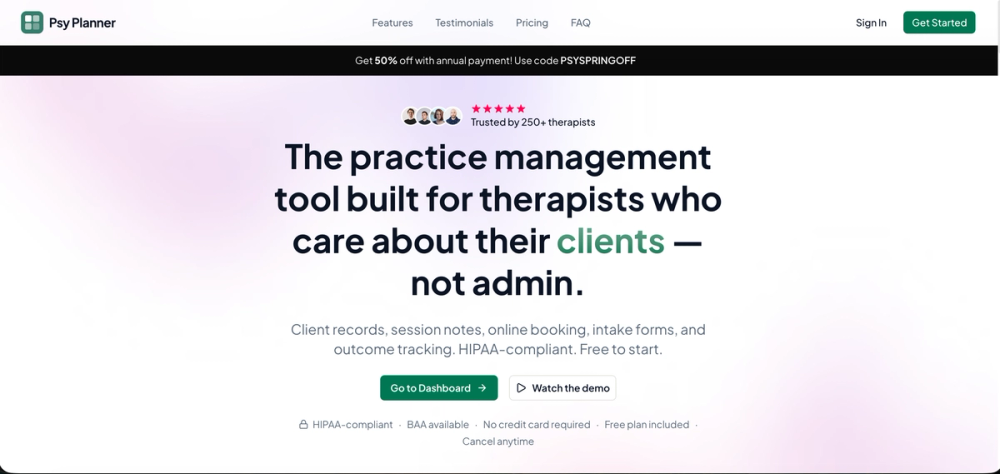
Psy Planner is practice management software for therapists and psychologists, with public messaging focused on client records, session notes, intake forms, scheduling, online booking, and outcome tracking. The product appears designed for mental health professionals who want one connected workspace instead of switching between separate tools for appointments, notes, and client administration.
The clearest value on the Psy Planner site is consolidation. It presents a therapist-focused system that supports day-to-day practice operations while keeping pricing and access relatively straightforward for solo or small-practice evaluators.
Key Features
- Client records, session notes, intake forms, and scheduling presented as connected parts of one workspace.
- Online booking that allows clients to book appointments directly into a Psy Planner calendar.
- Appointment scheduling for planning, rescheduling, and tracking sessions.
- Outcome tracking, listed in the public meta description as part of the practice management feature set.
- HIPAA-compliant storage and BAA availability, according to the public page.
- A product demo video shown on the homepage, giving prospective users a way to preview the workflow.
- Free-plan access with an upgrade path for practices that need more capability.
Use Cases
Psy Planner is most relevant for therapists or psychologists who want to reduce the operational friction around running a practice. The public page emphasizes records, notes, intake forms, and scheduling in one place, which suggests a use case where a clinician wants fewer disconnected admin steps before and after client sessions.
It also appears useful for practices that want clients to take more responsibility for booking appointments. The site says clients can book directly into the Psy Planner calendar, which can help reduce back-and-forth scheduling if the booking rules fit the practice's workflow. Clinicians should still verify how calendar settings, availability controls, reminders, and client-facing booking pages work before adopting it.
A third use case is practice evaluation and progress tracking. Outcome tracking is listed as a feature, but the visible evidence does not explain the available measures, reporting depth, or clinical templates. That makes it a promising area to inspect during a demo rather than a capability to assume in detail.
Pricing
The public page says Psy Planner has a free plan and that users can start free, upgrade when ready, and avoid long-term lock-in. It also shows messaging around no credit card required, cancellation at any time, and a 50% annual-payment offer using code PSYSPRINGOFF, with copy that says annual payment can save $140, described as six months free. Because offers can change, practices should verify the current plan limits, annual discount terms, and which features are included before choosing a paid plan.
User Experience and Support
The site frames Psy Planner as "everything you need to run your practice - nothing you don't," which suggests a product trying to stay focused on therapy practice operations rather than a broad business suite. The visible workflow centers on a calendar, client booking, client records, session notes, intake forms, and outcome tracking. That is a practical set of signals for a clinician comparing tools, though a hands-on trial would still be necessary to judge speed, note-taking comfort, and daily usability.
Support signals are present but not deeply detailed in the fetched page. The FAQ area includes questions about free trials, calendar integrations, direct client booking, whether clients need to download anything, cancellation, and customer support. The page also includes a "Talk to us" prompt and a "Contact us" line. A practice that requires fast support, onboarding help, or documented service commitments should ask about those expectations before moving client operations into the product.
Technical Details
Psy Planner presents itself as HIPAA-compliant practice management software and says a BAA is available. It also mentions HIPAA-secure storage, client records, session notes, intake forms, scheduling, outcome tracking, online booking, and calendar integration questions in the FAQ. These are important technical and operational signals for a therapy practice evaluating client-data workflows.
The visible evidence does not show implementation details such as supported calendar providers, data export formats, mobile app availability, role permissions, audit logs, or integration setup steps. Those details matter for larger practices, compliance review, and migration planning, so they should be confirmed directly with Psy Planner before a practice relies on the platform as its central system.
Pros and Cons
Pros
- Clear focus on therapists and psychologists rather than generic appointment scheduling.
- Combines client records, notes, intake forms, scheduling, booking, and outcome tracking in one stated workspace.
- Free-plan and no-credit-card messaging reduce the barrier to initial evaluation.
- Public page highlights HIPAA-compliant storage and BAA availability, which are important buying considerations for mental health practices.
- Direct client booking can reduce scheduling friction if it fits the practice's appointment rules.
Cons
- Only the primary page was available in the fetched evidence, so deeper workflow details are limited.
- Calendar integration is mentioned as an FAQ topic, but supported providers and setup details are not visible in the captured text.
- Outcome tracking is listed, yet the public evidence does not explain measures, templates, reporting, or export options.
- Support is signaled through contact prompts, but response times, onboarding options, and support channels are not clearly described.
- Practices with complex compliance, multi-provider, or migration needs will need more information than the homepage provides.
FAQ
What is Psy Planner and what problem does it solve?
Psy Planner is practice management software for therapists and psychologists. It is presented as a connected workspace for client records, session notes, intake forms, scheduling, online booking, and outcome tracking.
Who is Psy Planner best suited for?
Psy Planner appears best suited for therapists, psychologists, and small mental health practices that want a focused practice-management tool. It may be most useful for clinicians trying to reduce tool-switching across scheduling, notes, records, and intake workflows.
Can clients book appointments directly with Psy Planner?
Yes. The public page says Psy Planner supports online booking and allows clients to book their own appointments directly into the clinician's calendar. Practices should verify the available booking controls, availability rules, and client notifications during evaluation.
Does Psy Planner support HIPAA-related needs?
The site states that Psy Planner is HIPAA-compliant, mentions HIPAA-secure storage, and says a BAA is available. A practice should still review the terms, BAA process, data handling details, and any internal compliance requirements before storing client information.
Is there a free plan or trial for Psy Planner?
The public page says users can start free, that no credit card is required, and that they can upgrade when ready. It also shows annual discount messaging, so readers should check the current pricing terms before subscribing.
Does Psy Planner integrate with calendars?
Calendar integration appears as a visible FAQ question, and the page discusses booking directly into a Psy Planner calendar. The captured evidence does not name supported external calendar providers, so users should confirm whether their preferred calendar system is supported.
What should a therapist verify before moving their practice to Psy Planner?
A therapist should verify note-taking workflow, intake form customization, calendar integration, client booking rules, data export options, outcome tracking depth, and support expectations. These details determine whether the product fits daily clinical operations rather than only the homepage checklist.
Do clients need to download anything to use Psy Planner?
The public page includes this as an FAQ question, but the captured text does not show the answer. Practices should confirm the client experience, especially whether booking, intake forms, or client-facing tasks require an account, app, or download.
Conclusion
Psy Planner presents a focused practice management option for therapists and psychologists who want records, notes, intake, scheduling, booking, and outcome tracking in one workspace. Its public page gives useful signals around free access, HIPAA-related positioning, and therapist-specific workflow needs.
The main thing to verify is depth: calendar integrations, support, outcome tracking, data handling, and client experience all deserve a close look before adopting any practice-management tool. For clinicians seeking a simpler administrative setup, Psy Planner is worth evaluating through its free access and demo materials.