
Introduction
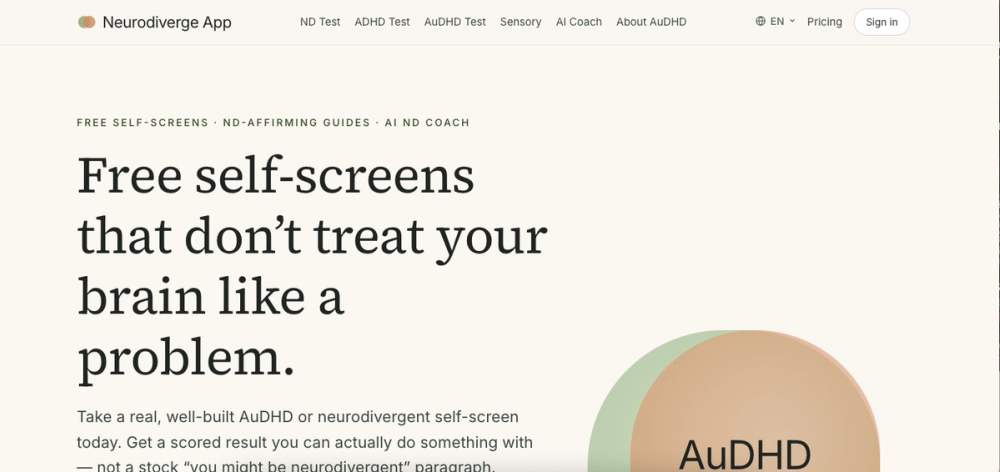
Neurodiverge App is a web-based platform offering free self-screening tools for autism, ADHD, AuDHD, and sensory processing differences, built from validated instruments and translated into plain English. The screens are designed for adults who suspect they may be neurodivergent but have not yet pursued formal diagnosis, and the site explicitly frames itself as neuroaffirming - it avoids pathologizing language and will not recommend Applied Behavior Analysis. For adults navigating the recognition process, whether triggered by a child's diagnosis, burnout, or reading someone else's story, the app provides a structured starting point that goes beyond a single-question quiz.
Key Features
- Four Self-Screening Tools - The platform offers a Neurodivergent Test (30 questions across six dimensions including autism, ADHD, dyspraxia, dyslexia, sensory processing, and tics), an AuDHD Test (20 questions covering the overlap of autism and ADHD), an Adult ADHD Test (20 ASRS-informed questions across four dimensions), and a Sensory Profile Test (24 questions across all eight sensory channels). Each screen takes between five and eight minutes.
- Scored Dimensional Results - Rather than a single "you might be neurodivergent" paragraph, each screen provides a six-dimension or per-channel scored profile. The Sensory Profile Test produces a radar-chart result with per-channel accommodation suggestions, while the AuDHD Test breaks down hyperfocus, masking, sensory load, and executive load.
- Identity-First, Neuroaffirming Language - The public site states it will never frame autistic, ADHD, or AuDHD traits as "symptoms of a disorder" and will not link to ABA resources. This positions the app as aligned with the neurodiversity paradigm rather than a clinical-disorder framing.
- AI ND Coach - Referenced in the navigation as part of the free offering, though specific details about what the coach does, how it works, or what data it uses are not visible in the fetched evidence.
- Educational Content on AuDHD - A dedicated section explains what AuDHD is, why it is often missed in women, and covers masking, burnout, and support strategies. The content is grounded in lived-experience accounts rather than clinical definitions.
Use Cases
For adults who have recently encountered the concept of AuDHD or neurodivergence - perhaps through a child's diagnosis, a partner's assessment, or social media content that resonated uncomfortably well - the self-screens offer a structured way to explore whether formal assessment might be worthwhile. The five recognition moments described on the public site (child's diagnosis, reading another adult's account, burnout, hormone shifts, and therapy surfacing the pattern) suggest the app understands its audience's entry points.
For individuals who have been through therapy for anxiety or depression without resolution, the dimensional scoring may help articulate specific patterns that standard mental health screenings miss. The Sensory Profile Test in particular maps across eight channels (hearing, sight, touch, smell, taste, balance, body, and interior), which could give someone concrete language to bring to a clinician conversation.
For people exploring whether they are autistic, ADHD, or both, the AuDHD Test addresses the specific overlap zone that many standard screens do not cover. The fact that it asks 20 questions about hyperfocus, masking, sensory load, and executive function - areas where autism and ADHD intersect - suggests the tool is designed for people whose experience does not fit neatly into a single-category assessment.
Pricing
The self-screens themselves are free with no signup required. The public site mentions an AI ND coach as part of the free offering. A pricing page exists (referenced in the navigation), but the fetched evidence does not detail specific paid tiers, subscription costs, or feature gates beyond the free screens. The site mentions a 14-day free trial in its meta description context, which suggests there may be a premium tier, though the exact features and pricing of that tier are not visible in the evidence provided.
User Experience and Support
The screens require no account creation to begin - the public site emphasizes "no signup to start, no diagnosis, no medical advice." Each screen allows skipping questions, which reduces friction for users who may find certain topics difficult to answer in the moment. The four- to eight-minute completion time per screen is short enough to try during a break or commute.
The site includes an FAQ section addressing common concerns about what the screens are (self-assessment tools, not diagnoses), what they are not (medical advice or clinical evaluations), and how the scoring works. The navigation includes links to educational content about AuDHD, which provides context beyond the screens themselves.
Technical Details
The self-screens are built from validated instruments where they exist, then translated into plain English and scored with dimensional profiles. The Neurodivergent Test covers six dimensions (autism, ADHD, dyspraxia, dyslexia, sensory, tics), the Adult ADHD Test uses ASRS-informed questions across four dimensions (inattention, hyperactivity, executive function, emotional regulation), and the Sensory Profile Test maps all eight sensory channels. The app is web-based and does not appear to require installation. An AI ND coach is mentioned in the navigation, though the underlying technology, data sources, and scope of the coach are not detailed in the evidence.
Pros and Cons
Pros
- All self-screens are free with no signup, removing barriers for people who want to explore privately
- Dimensional scoring provides more useful output than single-score quizzes, giving users specific language to discuss with clinicians
- AuDHD Test specifically addresses the autism-ADHD overlap, which most standard screens do not cover
- Neuroaffirming language and explicit rejection of ABA framing signals alignment with the neurodiversity community's values
- Sensory Profile Test's eight-channel radar chart with per-channel accommodations is practically useful beyond screening
Cons
- The AI ND coach is mentioned but not described in detail, making it hard to evaluate its usefulness or safety
- Pricing details beyond the free screens are not visible in the fetched evidence, which limits evaluation of any paid features
- No information about data privacy, storage, or encryption is visible on the public pages - a concern for a tool collecting sensitive personal information
- The site does not clearly state who built the screens or whether any clinicians or neurodivergent professionals were involved in their creation
FAQ
What is the Neurodiverge App and who is it for?
Neurodiverge App is a free, web-based platform offering self-screening tools for autism, ADHD, AuDHD, and sensory processing differences. It is designed for adults who suspect they may be neurodivergent and want a structured starting point before pursuing formal assessment. The screens are not diagnostic tools and do not replace clinical evaluation.
Are the self-screens a diagnosis?
No. The public site explicitly states these are self-assessment tools, not diagnoses. They are built from validated instruments where available, translated into plain English, and scored to provide dimensional profiles - but they are not clinical evaluations and should not be treated as medical advice.
What is AuDHD and why does it matter for screening?
AuDHD refers to the lived experience of being both autistic and ADHD. Many standard screening tools assess autism and ADHD separately, which can miss people whose traits span both categories. The Neurodiverge App's AuDHD Test specifically targets the overlap areas - hyperfocus, masking, sensory load, and executive function - where the two conditions intersect.
How long do the screens take?
Each screen takes between four and eight minutes. The Neurodivergent Test (30 questions) takes approximately eight minutes, while the AuDHD Test, Adult ADHD Test, and Sensory Profile Test each take five to six minutes. You can skip any question.
Is my data private?
The public site does not detail its data privacy practices, storage methods, or encryption standards. For a tool that collects sensitive personal information about neurodivergent traits, this is an area where a careful user should look for a privacy policy or contact the team directly before completing a screen.
Does the app recommend treatments or clinicians?
The public site states it will not recommend Applied Behavior Analysis and will not link to clinicians or content that does not align with neuroaffirming principles. The screens are designed to help users understand their own patterns, not to direct them toward specific treatments or providers.
Conclusion
Neurodiverge App fills a genuine gap in the neurodivergent self-assessment landscape by offering structured, dimensionally-scored screens that go beyond the typical single-page quiz. The AuDHD-specific screen is particularly valuable for people whose experience spans autism and ADHD, and the neuroaffirming framing signals that the tool is built with community input rather than a clinical-disorder lens. For adults exploring whether they might be neurodivergent, the free, no-signup screens provide a private starting point - though users should verify the app's data privacy practices and understand that these tools are not substitutes for professional assessment.