
Introduction
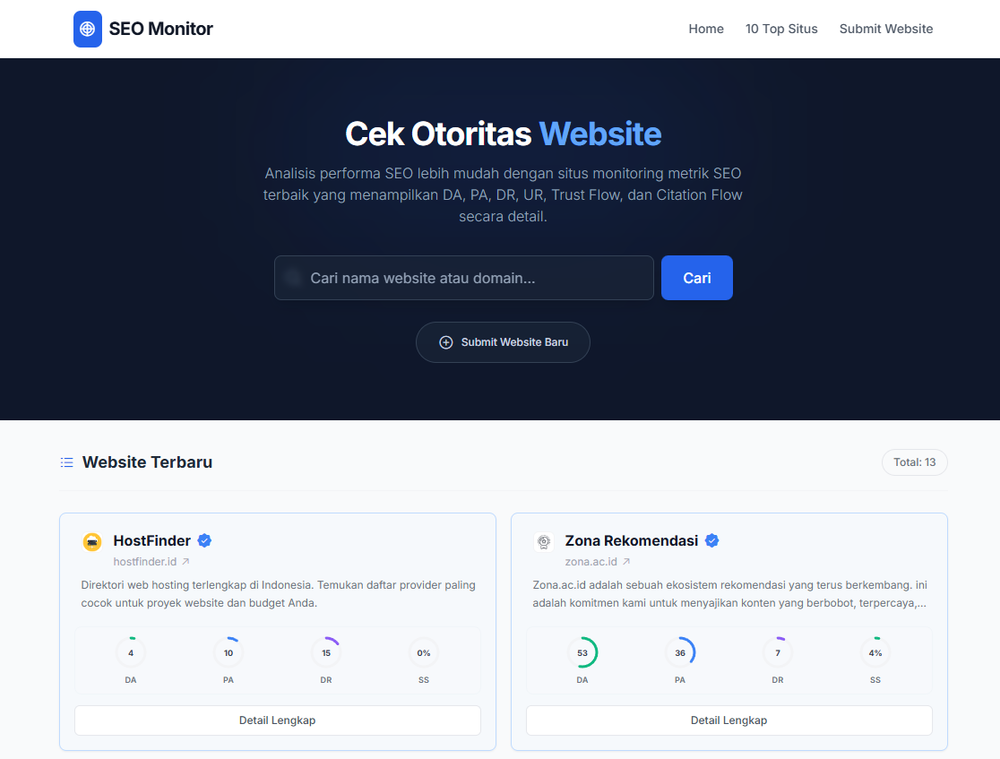
SEO Metrics Monitor is presented as a website authority checker and SEO metric monitoring page for evaluating domain-level signals. The public page describes a free authority-checking experience focused on DA, PA, DR, UR, Trust Flow, and Citation Flow, making it relevant for site owners, SEO practitioners, and content teams that want a quick directional view of website authority metrics. A careful evaluator should treat the page as a visible SEO metrics reference point and verify data sources, update frequency, and usage limits before relying on it for client reporting or major SEO decisions.
Key Features
- Website authority checking centered on visible SEO metrics such as DA, PA, DR, UR, Trust Flow, and Citation Flow.
- A public homepage at SEO Metrics Monitor that positions the tool around easier SEO performance analysis.
- Indonesian-language page copy, which suggests the product is aimed at users who are comfortable evaluating SEO tools in an Indonesian web context.
- A "Cek Otoritas Website" heading that makes the core workflow clear: checking website authority.
- Related website listings on the same page, including hosting, blog, service, and technical product references, which may help users discover adjacent web resources.
- Concise page presentation with the main product promise visible early rather than hidden behind long onboarding copy.
Use Cases
SEO Metrics Monitor appears most useful for quick website authority checks when a user wants to review high-level SEO indicators before deeper analysis. The visible metrics are commonly used as comparative signals, so the tool may fit early-stage evaluations of domains, backlink prospects, owned websites, or competitor sites, provided users understand that these metrics are directional rather than a complete SEO diagnosis.
For marketers, bloggers, and website owners, the page can serve as a lightweight starting point for deciding which domains deserve closer inspection. The available copy does not show workflow details, report exports, historical tracking, or data-source explanations, so teams using it for professional SEO work should confirm how results are calculated and whether the tool supports repeatable reporting.
The page also includes several recent or related website entries, such as hosting, media, service, and technical resources. That context suggests the site may sit within a broader web-resource ecosystem, but the product profile should remain centered on its stated purpose: checking website authority and surfacing SEO metric signals.
Pricing
The public page describes SEO Metrics Monitor as "Cek Otoritas Website Gratis," which indicates a free website authority check is part of the visible positioning. It does not show detailed pricing tiers, paid plans, account limits, API access, or billing terms in the fetched evidence. Readers who plan to use the tool regularly should verify whether free checks have usage caps, whether advanced features require payment, and whether commercial use is permitted.
User Experience and Support
The visible page keeps the product message direct: it presents an SEO metrics monitor for DA, PA, DR, UR, Trust Flow, and Citation Flow. That makes the basic purpose easy to understand, especially for users already familiar with SEO authority metrics. The page also uses Indonesian copy, so it may feel more approachable for local users or teams working in that language.
Support details are not clearly visible on the public page. There are no confirmed help center, documentation, contact, tutorial, or support-channel details in the visible site copy. Before adopting SEO Metrics Monitor for recurring SEO work, users should check whether the site provides guidance on metric interpretation, troubleshooting, data freshness, and contact options.
Technical Details
The strongest technical signal on the page is the list of SEO authority metrics: DA, PA, DR, UR, Trust Flow, and Citation Flow. These signals suggest the product is built around third-party-style SEO measurement concepts, but the public copy does not explain the data providers, calculation methodology, crawl frequency, or whether the metrics are pulled live or cached.
The available evidence does not confirm integrations, API access, export formats, browser extensions, or dashboard accounts. For technical teams, the main verification step is to confirm where the metric data comes from, how often it updates, and whether the tool can be integrated into a repeatable SEO workflow rather than used only as a manual checker.
Pros and Cons
Pros
- Clearly communicates its main purpose as a website authority and SEO metric checker.
- Mentions several recognizable authority-style metrics, including DA, PA, DR, UR, Trust Flow, and Citation Flow.
- Public page positioning suggests a free authority-checking use case.
- Useful as a lightweight first step for evaluating domains before deeper SEO research.
Cons
- Pricing, limits, and account requirements are not described in detail on the visible page.
- The page does not clearly explain data sources, update frequency, or calculation methods for the listed metrics.
- Support, documentation, and contact options are not visible in the fetched evidence.
- Use-case depth is limited, so professional users may need to test whether the tool fits client reporting or monitoring workflows.
FAQ
What is SEO Metrics Monitor used for?
SEO Metrics Monitor is presented as a free website authority checker and SEO metric monitoring page. The visible copy says it helps analyze SEO performance through metrics such as DA, PA, DR, UR, Trust Flow, and Citation Flow.
Who is SEO Metrics Monitor suited for?
It appears suited for website owners, SEO practitioners, bloggers, and marketers who want a quick look at domain authority-style signals. Users who need audited reports, historical tracking, or verified data methodology should confirm those details before depending on it.
Which SEO metrics are visible on the public page?
The public page specifically mentions DA, PA, DR, UR, Trust Flow, and Citation Flow. It does not explain the source or calculation method for each metric, so readers should treat the values as indicators to verify alongside other SEO tools.
Does SEO Metrics Monitor show pricing or paid plan details?
The page uses the phrase "Cek Otoritas Website Gratis," which points to a free authority-checking offer. Detailed pricing tiers, usage limits, paid features, and billing terms are not visible on the public page.
Does the site explain where its SEO data comes from?
The visible page does not clearly state data providers, update frequency, or methodology. That is an important point to verify if the tool will be used for professional SEO audits, competitor research, or recurring client reports.
Can SEO Metrics Monitor replace a full SEO audit platform?
The public evidence supports a narrower role: checking website authority metrics. A full SEO audit usually requires technical crawling, content analysis, backlink review, rank tracking, and issue prioritization, none of which are clearly shown on the fetched page.
What should users verify before relying on SEO Metrics Monitor?
Users should verify metric accuracy, data sources, refresh timing, usage limits, support availability, and whether results can be saved or exported. These details matter if the tool will be part of a regular SEO workflow rather than a one-off check.
Conclusion
SEO Metrics Monitor gives users a straightforward way to evaluate website authority through familiar SEO metric labels. Its clearest value is quick visibility into DA, PA, DR, UR, Trust Flow, and Citation Flow, while its main limitation is the lack of visible detail around pricing, support, methodology, and integrations. It is worth considering as a lightweight checking tool, with further verification needed before using it for formal SEO reporting.