
Introduction
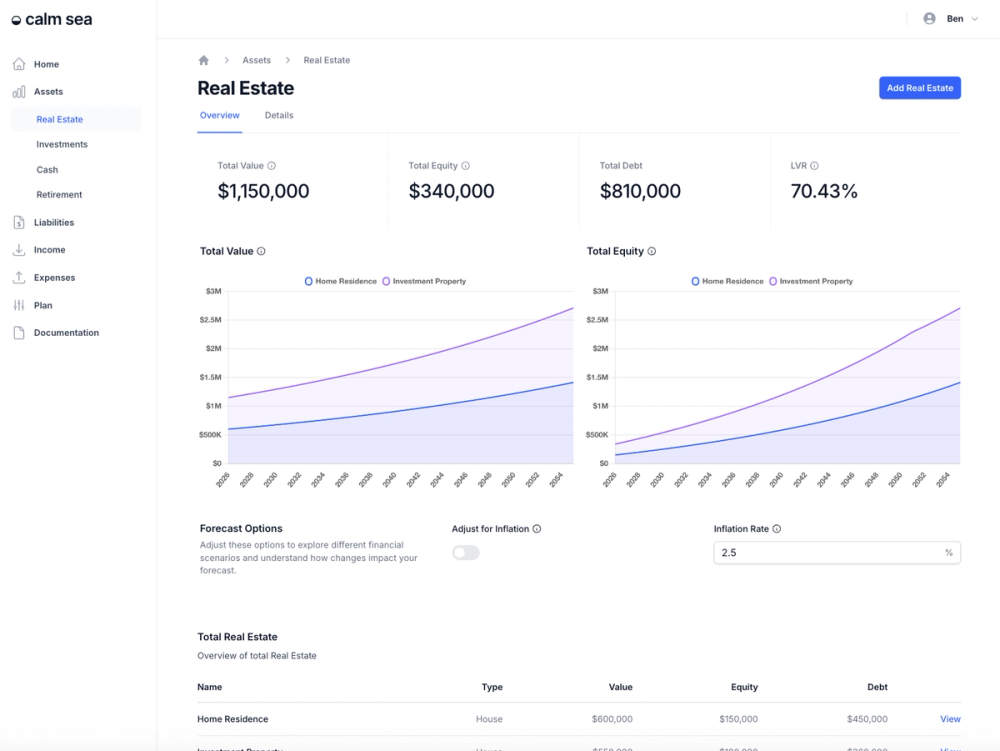
Calm Sea is a browser-based financial planning tool that aggregates your assets, liabilities, income, and expenses into a single visual dashboard and then projects your wealth forward over time. Built for individuals who want retirement-readiness clarity without a spreadsheet or bank linking, the platform focuses on making net worth tracking and scenario planning straightforward and visual.
The product addresses a specific gap in personal finance: most budgeting tools look backward at past spending, while Calm Sea looks forward at whether your current trajectory gets you to retirement. That forward-looking orientation is the core promise, and the site leans into it heavily with interactive projections and scenario modeling.
Key Features
- Unified net worth view: Consolidate property, investments, retirement accounts, savings, and any other assets into a single visual dashboard showing total net worth and growth over time
- Forward-looking projections: Model how your assets could grow based on user-defined assumptions for inflation, interest rates, and contribution changes, with adjustments visible in real time
- Retirement drawdown planning: Set retirement accounts, investment goals, and lifestyle targets to see how they shape your income strategy and projected retirement date
- What-if scenario testing: Change variables such as savings rate, interest rate, or inflation assumptions and watch the impact shift across your entire financial timeline instantly
- Cash flow forecasting: Input assumptions to project future cash flow and explore how rate or expense changes affect your financial position over time
- Manual-entry privacy model: No bank linking or credential sharing required; all data is entered manually, which keeps setup simple and eliminates third-party account access
Use Cases
For someone with a 401(k), a brokerage account, some savings, and maybe a property who has never seen those pieces add up in one place, Calm Sea provides the consolidated view. The value is less about tracking daily transactions and more about answering the question "is my current savings trajectory actually enough for retirement?" The scenario modeling makes it possible to see how a 2% increase in savings rate or a change in assumed returns would shift a retirement timeline by years.
Couples or individuals approaching retirement planning for the first time may find the visual dashboard approachable compared to spreadsheets or financial advisor consultations. The manual-entry model also suits privacy-conscious users who are uncomfortable connecting financial accounts to third-party apps. The product appears designed for people who want to answer their own retirement questions rather than delegate the analysis.
Pricing
Calm Sea offers a free tier that includes asset projections, loan repayment calculators, cash flow analysis, and a contributions calculator. An Everyday Users upgrade adds data saving and additional features. The pricing page also mentions a lifetime access option described as a one-time purchase with no ongoing commitment, though the specific dollar amount for the paid tier is not prominently displayed on the main pages that were fetched.
User Experience and Support
The platform emphasizes a three-step onboarding flow: enter assets and income, view the net worth dashboard, then explore projections and scenarios. The site describes the interface as visual-first with clean charts and real-time updates. Support resources include a Help & Guides section, a glossary of terminology, and a blog with calculators. The about page identifies the company as Calm Sea Technology Pty Ltd with a founder named Ben, and the founder's personal message is included on the about page, suggesting a small, early-stage operation.
Technical Details
Calm Sea runs entirely in the browser with no bank linking or API integrations to financial institutions. The platform supports manual data entry for assets, liabilities, income, and expenses. Projections use user-defined assumptions for growth rates, inflation, and contribution changes. The service appears to be a web application accessible globally, with a primary focus on the US and Europe based on the about page description. No mobile apps, browser extensions, or third-party integrations are mentioned in the fetched evidence.
Pros and Cons
Pros
- Free tier includes core projection and cash flow tools, making it accessible without upfront commitment
- Manual-entry model eliminates bank linking requirements and keeps financial credentials off the platform
- Real-time scenario modeling allows users to see the impact of assumption changes instantly
- Visual-first approach makes net worth and retirement projections more accessible than spreadsheet-based alternatives
Cons
- The free tier does not save data between sessions, limiting usefulness for ongoing tracking
- No bank integration means all data must be entered and updated manually, which could become tedious
- The paid pricing details are not prominently displayed on the main pages, making it hard to evaluate cost before signing up
- The platform is early-stage with a small team, which may affect support responsiveness and feature development speed
FAQ
What is Calm Sea and who is it designed for?
Calm Sea is a web-based financial planning tool that tracks net worth across multiple asset types and projects your wealth forward over time. It appears designed for individuals who want retirement-readiness visibility without using spreadsheets or connecting their bank accounts to a third-party service.
Does Calm Sea connect to my bank accounts?
No. Calm Sea is entirely manual-entry, meaning you enter your own financial data without granting any bank access or credential sharing. This keeps the setup simple and your financial credentials private.
What does the free plan include?
The free tier provides access to asset projections, loan repayment calculators, cash flow analysis, and a contributions calculator. However, your data is not saved between sessions on the free plan, so you would need to re-enter information each time unless you upgrade.
Is there a paid plan, and what does it cost?
Yes. The Everyday Users plan adds data saving and additional features. The site also mentions a lifetime access option as a one-time purchase. The exact pricing for the paid tiers is not prominently displayed on the main pages that were fetched, so you would need to check the pricing page directly for current rates.
Is my data secure on Calm Sea?
The site states that data is encrypted at rest and in transit, and that no third-party data sharing or selling occurs. Because Calm Sea does not connect to financial institutions, you are only ever entering numbers rather than credentials, which reduces exposure. The about page also notes that deleted data is permanently removed and cannot be restored.
Can I use Calm Sea outside the United States?
Yes. The platform is built for a global audience with a primary focus on the US and Europe. Since you enter your own numbers and assumptions, the core tools work regardless of your location, though specific tax or retirement account integrations do not appear to be part of the current feature set.
What should I verify before relying on Calm Sea for retirement planning?
The site includes a disclaimer that its tools are for educational and informational purposes only and do not constitute financial advice. Before making retirement decisions based on projections, you should verify the assumptions you input against current market conditions and consider consulting a qualified financial advisor, especially for complex tax or investment scenarios.
Conclusion
Calm Sea fills a clear niche for individuals who want forward-looking retirement projections without bank integration or spreadsheet complexity. The free tier makes it easy to test the core experience, and the real-time scenario modeling is the most compelling feature for anyone trying to answer whether their savings trajectory is on track. The main trade-offs are the manual data entry requirement and the early-stage nature of the product, both of which are worth evaluating against your specific planning needs before relying on it as a primary financial tool.